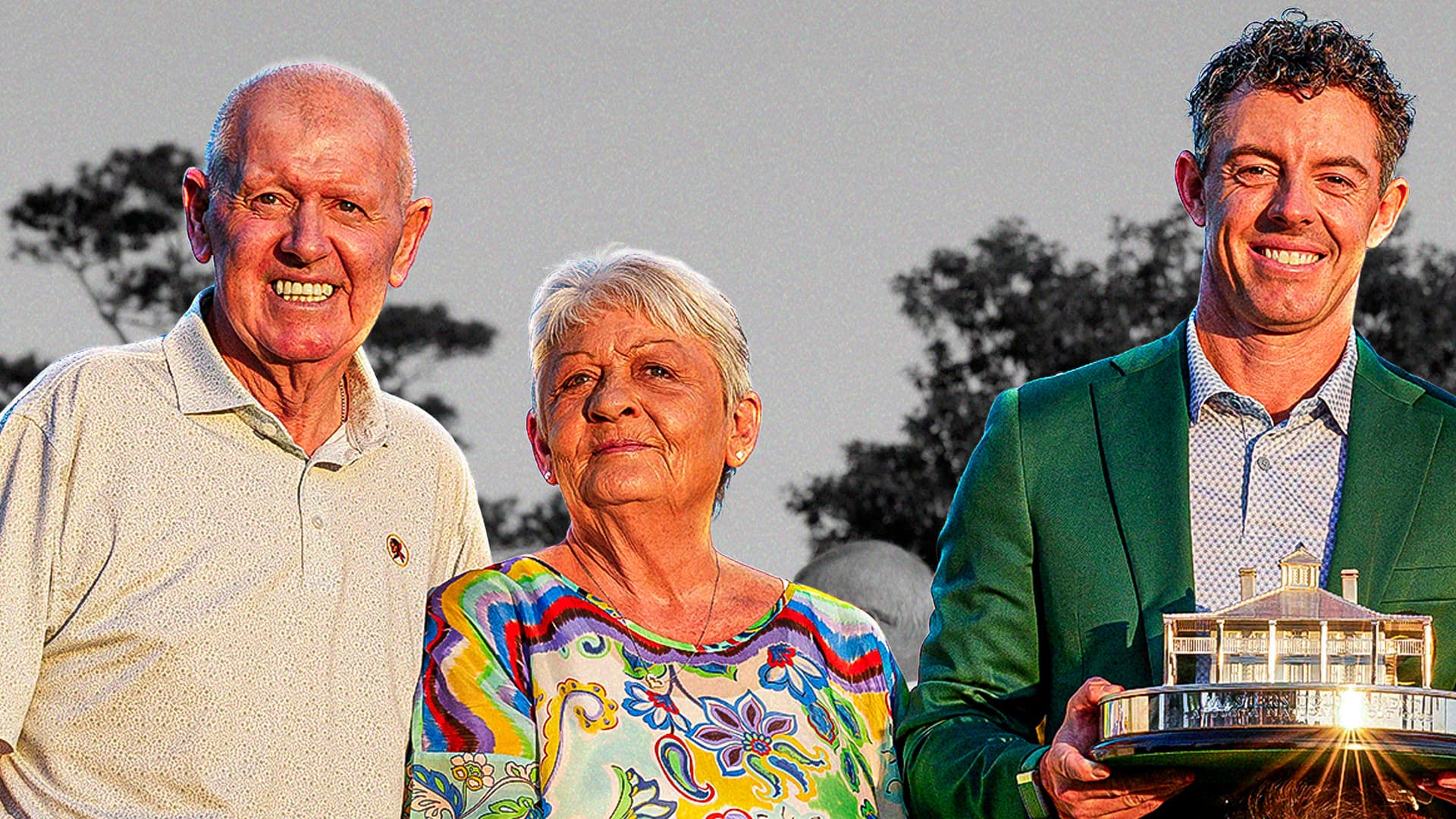

Rory McIlroy just did something only three other golfers in the 90-year history of the Masters Tournament have ever done. On Sunday at Augusta National, the 36-year-old from Holywood, Northern Ireland won his second consecutive green jacket, joining Jack Nicklaus, Nick Faldo, and Tiger Woods in one of the most exclusive clubs in all of sports.
And in typical Rory fashion, he didn’t make it easy on himself.
After building a record-setting six-shot lead through 36 holes, McIlroy watched it evaporate entirely during a shaky third round, entering Sunday tied with Cameron Young at 11-under. With Justin Rose surging ahead on the front nine and Scottie Scheffler lurking, McIlroy trailed at multiple points during the final round. Then he did what champions do — he went on a birdie run through the heart of Augusta’s back nine, built a cushion, and held on to win by one.
It was, by any measure, a spectacular performance under extraordinary pressure. But if you’re a parent or a coach in the youth sports world, the final-round drama isn’t the most interesting part of this story. The most interesting part is everything that came before it.
A Plastic Club and a Washing Machine
Rory McIlroy didn’t come from a golf family in any traditional sense. His dad Gerry was a good amateur player — a scratch golfer at Holywood Golf Club — but he wasn’t wealthy, wasn’t connected, and wasn’t a member of some elite country club pipeline. He managed a bar in Belfast. Rory’s mom Rosie worked as a waitress at that same bar. They married in 1988 in a small church in Holywood, a coastal town of about 12,000 people east of Belfast.
What they had was an only child who, by the time he could walk, was obsessed with golf. Rory was hitting 40-yard drives with plastic clubs at age two. He was chipping balls into the family washing machine for fun. By seven, he was the youngest member of Holywood Golf Club. By nine, he’d won the World Under-10 Championship in Miami. By twelve, he was playing to scratch.
His parents saw the talent and made a decision that would shape their entire lives: they’d do whatever it took to give their kid a chance. Gerry started working 100-hour weeks — cleaning toilets and showers at a local sports club in the mornings, bartending at Holywood Golf Club from noon to six, then working behind the bar at the sports club again in the evenings. Rosie looked after Rory during the day and worked overnight shifts packaging tape at a 3M factory. They rarely saw each other. They didn’t take a family vacation for over a decade. Everything went toward lessons, travel to competitions, and the lighted practice green they installed in the yard behind their modest brick house.
“I had no idea what else to do,” Gerry has said. “I’m a working-class man. We wanted to give our only child a chance.”
The Part Nobody Wants to Talk About
In the youth sports world, the McIlroy origin story is typically told as an uncomplicated fairy tale: loving parents sacrifice everything, prodigious child works hard, dreams come true. And on its face, that narrative is accurate.
But it’s also worth sitting with some of the details that tend to get glossed over, because they raise questions that every serious youth sports parent has to wrestle with.
Rory left school at 16 to focus entirely on golf. His school principal, John Stevenson, later described how Gerry frequently requested that Rory be allowed to miss school, eventually leading to his course load being cut from nine subjects to five before he left altogether. Stevenson was initially skeptical, but ultimately decided that if Rory’s parents had made such extraordinary sacrifices, the school needed to support them too.
There’s also the now-famous bet: when Rory was just 15 years old, Gerry and a group of friends pooled together 400 pounds and placed a wager at 500-to-1 odds that Rory would win the Open Championship before turning 26. Depending on how you look at it, that’s either a charming display of fatherly belief or a very specific kind of financial projection placed on a teenager’s shoulders. (Rory has said his father never once mentioned the bet to him, and it paid out — roughly $340,000 — when Rory won the 2014 Open Championship at age 25.)
And then there’s the broader picture: a family that essentially sacrificed its own togetherness — parents who barely saw each other for years — in service of one child’s athletic development. The kid appeared on national television at age nine. He was competing internationally before he hit double digits. He turned pro at 18.
None of this is necessarily wrong. In fact, the outcome suggests the McIlroys read the room correctly. But it’s important to acknowledge that this path carries real risk — risk that is almost always invisible when it works out, and painfully obvious when it doesn’t. For every Rory McIlroy, there are hundreds of families who made similar sacrifices for a child who didn’t become a six-time major champion. The bet doesn’t always pay out.
What Rory Himself Has Said About It
Here’s what makes the McIlroy story more nuanced than a typical “pushy parent” debate: Rory has been remarkably consistent in insisting that the drive was always his.
“I just looked like a kid that loved golf,” he’s said. “I just really had a passion for the game.” His longtime coach Michael Bannon, who’s worked with Rory since he was eight years old and remains his coach today, has echoed this: there was no master plan, no grand scheme to manufacture a superstar. Just guidance and support for a wildly enthusiastic boy chasing a dream.
Rory has also spoken candidly about not fully understanding his parents’ sacrifices until he turned pro and started earning his own money. “You don’t realize it at the time,” he told The Open in 2022. “But when you get a little older you start to realize, ‘OK, this isn’t normal what they did for me.’”
And perhaps the most telling window into how Rory has internalized this experience comes from how he talks about raising his own daughter, Poppy. In an interview earlier this year, McIlroy said plainly: “I don’t want her to have to think that she has to play golf to appease me or spend time with me. I’ve done a horrible job as a father if that’s what she thinks.”
That’s not a man running from his upbringing. That’s a man who has thought deeply about the line between support and pressure, and who clearly believes his parents landed on the right side of it — while also recognizing how easily it could have gone the other way.
The Failure That Built the Champion
If you want to understand why Sunday’s win matters so much, you have to go back to 2011.
A 21-year-old Rory McIlroy walked into the final round of the Masters with a four-shot lead and the entire golf world expecting a coronation. What happened instead was one of the most public collapses in the sport’s history. A wayward drive at the 10th hole triggered a catastrophic spiral: triple bogey, bogey, double bogey. He shot 80 and finished tied for 15th. He cried on the phone with his parents the next morning.
That day haunted him for 14 years. Every time he returned to Augusta and came up short — and there were many close calls — the ghost of 2011 was right there. When he finally won the Masters in 2025 to complete the career Grand Slam, he credited the 2011 disaster directly. He said he lost that tournament because he started looking around, checking leaderboards, playing mental math about what the other guys were doing. By 2025, he’d learned to set an internal target and block out everything else.
This is where the parent and coach takeaway gets personal. Every kid who plays competitive sports will, at some point, experience a version of what Rory experienced in 2011. Maybe it’s blowing a lead in a conference championship. Maybe it’s a bad at-bat with the game on the line. Maybe it’s falling off the balance beam at the state meet. The scale is different; the emotional reality is the same.
What you do in that moment — what you say in the car ride home, how you handle the next practice, whether you treat the failure as a verdict or a lesson — is one of the most consequential things you’ll ever do as a parent or a coach. Rory’s parents didn’t pull him out of golf after 2011. They didn’t overhaul his approach. They let him feel it, process it, and grow from it. Fourteen years later, that failure was the foundation of his greatest triumph.
Sunday in Augusta
Which brings us back to this weekend.
McIlroy entered Sunday tied for the lead after watching his record six-shot advantage disappear. He fell two behind Cameron Young after a double bogey at the fourth hole. Justin Rose, the same man Rory beat in a playoff to win his first green jacket a year ago, surged to the top of the leaderboard with five birdies on the front nine. Scottie Scheffler, the world’s number one player, was marching up the board with bogey-free precision.
It could have been 2011 all over again. The narrative was right there, ready to be written.
Instead, McIlroy birdied five of six holes from the seventh through the 13th, built a three-shot cushion, and held on despite a nervy finish that included a wayward tee shot into the trees on 18. He finished at 12-under, one clear of Scheffler.
And then came the moment that will stay with me. Rory walked off the 18th green and found his parents waiting. Gerry and Rosie had missed last year’s win — they’d watched from their living room in Northern Ireland. They almost didn’t come this year either, worried they’d jinx it. But they came. And there they were.
“You’re the most wonderful parents,” Rory said afterward. “And if I can be half the parent to Poppy that you were to me, then I know I’ve done a good job.”
What This Means for the Rest of Us
It would be easy to wrap this story up with a neat bow: believe in your kid, support their dreams, and everything works out. But that’s not honest, and it’s not useful.
The truth is that the McIlroy family’s story contains a genuine tension that every youth sports parent lives with. Gerry and Rosie made choices that most parenting experts would caution against — pulling a kid from school, working themselves into the ground, orienting an entire family’s existence around one child’s sport. Those choices worked spectacularly well because Rory happened to be, quite literally, one of the most talented golfers who has ever lived, and because the drive was genuinely his.
But here’s what I think parents and coaches can take from this story, regardless of whether your kid is destined for a green jacket or just wants to make the JV team:
Follow the child’s lead, not your own. The McIlroy story works because Rory’s obsession was organic. He wasn’t pushed into golf — he dragged his parents into it. The most important question you can ask yourself as a youth sports parent isn’t “how good is my kid?” It’s “whose dream is this?”
Failure is not a crisis. It’s curriculum. The 2011 Masters collapse didn’t end Rory McIlroy’s career. It built it. When your kid has their worst game, that’s not a tragedy — it’s tuition. The lessons they internalize from those moments will serve them decades longer than any trophy.
Be honest about survivorship bias. We tell the Rory McIlroy story because it has a happy ending. We don’t tell the thousands of stories where families made identical sacrifices and the kid burned out, got injured, or simply wasn’t quite talented enough. That doesn’t mean you shouldn’t invest in your child’s development. It means you should invest in the person, not just the athlete.
The journey has to be the point. After winning his fifth major last year, Rory admitted he thought completing the Grand Slam would make him happy — but the goalposts just kept moving. “If you can just really find enjoyment in the journey, that’s the big thing,” he said. That’s wisdom from a man who’s reached the absolute summit of his sport and is still learning this lesson in real time.
Rory McIlroy is now a six-time major champion, tied with Nick Faldo and Phil Mickelson for 12th all-time. He’s 36 years old, still at the peak of his powers, and by his own admission, nowhere close to done. Somewhere in Holywood, Northern Ireland, at a modest golf club on a hillside overlooking Belfast Lough, the members are probably pouring one more pint and telling one more story about the little boy who wouldn’t stop swinging.
Gerry and Rosie McIlroy bet everything on that boy. But the real bet was simpler than it looked: they bet that if they followed his lead, he’d find his way. He sure did.

GET YOUTH INC UPDATES
Get real tools, fresh perspective, and inspiring stories to help you get the most from youth sports. Plus, you'll be entered for a chance to win premium fan wear to rep your favorite school or club